
The Goodman Line
Thomas Goodman was born in about 1821 in Sedgley, Staffordshire. He was a miner. On 3rd November 1844 he married Hannah Tipper, a widow born Hannah Bradford, in Wolverhampton. Hannah was a Nailer. Her father, T.Bradford was also described as a Nailer on the marriage certificate. Nail making was quite an industry in the midlands at this time. The job was hard, dirty and poorly paid but made the industrial bosses of the time very wealthy. Thomas and Hannah were illiterate.
Thomas and Hannah lived in the Wolverhampton district and their seven children were born in that area.
Thomas b.1841 John b.1843 Samuel b.1845 Mary b.1847 George b.1849 Betsy b.1851 Jane b.1860
Thomas and Hannah lived in the Wolverhampton district and their seven children were born in that area.
Thomas b.1841 John b.1843 Samuel b.1845 Mary b.1847 George b.1849 Betsy b.1851 Jane b.1860
Samuel was born on 13th April 1845 and at this time the family lived at Old Mill Croft, Sedgley. On 23rd April 1867 Samuel married Mary Jane Westwood at St James Parish Church, Ogley Hay, Staffordshire. Mary Jane was born in Sedgley in 1848. At the time of the marriage Samuel was described as a Collier and lived at Brownhills, Staffordshire which is on the A452 north of Birmingham. Mary’s father was a Stone Mason called John Westwood.
Samuel and Mary Jane had eight children
Sarah Hannah b.1867 John Thomas b.1873 Ada E b.1876 Samuel b.1880 George b.1883 Lillian b.1887 Harry b.1889 Daisy b.1892.
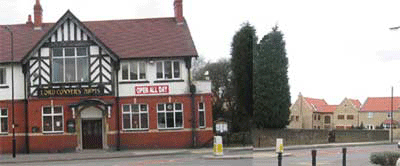
At the time of the 1901 census Samuel and his family had moved to 30 Wales Road, Kiveton Park, South Yorkshire. On the census document, No.30 was between the Lord Conyers Arms and the Vicarage. The Lord Conyers Arms is now a private dwelling but an old wall around a new development to the right looks as if it could have belonged to the vicarage. It seems that 30 Wales Road no longer exists. A narrow path to the right of the Lord Conyers Arms leads to a grassed area which could have been the site of some cottages.
Samuel and Mary Jane had eight children
Sarah Hannah b.1867 John Thomas b.1873 Ada E b.1876 Samuel b.1880 George b.1883 Lillian b.1887 Harry b.1889 Daisy b.1892.
At the time of the 1901 census Samuel and his family had moved to 30 Wales Road, Kiveton Park, South Yorkshire. On the census document, No.30 was between the Lord Conyers Arms and the Vicarage. The Lord Conyers Arms is now a private dwelling but an old wall around a new development to the right looks as if it could have belonged to the vicarage. It seems that 30 Wales Road no longer exists. A narrow path to the right of the Lord Conyers Arms leads to a grassed area which could have been the site of some cottages.
George Goodman was born in 17.03.1883 in Wales, a small village in South Yorkshire and in 1907 married Nora Lee in Enniscorthy, Ireland. Nora’s parents originally lived in Beighton near Sheffield but moved to Ferns, Co. Wexford, Ireland in about 1882 leaving some of their grown up children living in England. I assume George and Nora met when she visited her family in England. There are many relatives living in Ferns decended from the Lee Family
George was a Miner and became a Deputy, I believe at Wales or Kiveton Park Colliery, South Yorkshire. He and Nora had three children.
Cyril (1908). Amy Lillie 20.11.1909 Doris Freeda 18.02.1914
Cyril worked at the pit but due to a disability, he worked at the pit head rather than down the mine. He married Connie quite late in life. They have no children.
George was a Miner and became a Deputy, I believe at Wales or Kiveton Park Colliery, South Yorkshire. He and Nora had three children.
Cyril (1908). Amy Lillie 20.11.1909 Doris Freeda 18.02.1914
Cyril worked at the pit but due to a disability, he worked at the pit head rather than down the mine. He married Connie quite late in life. They have no children.
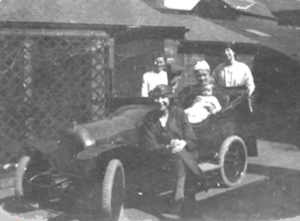
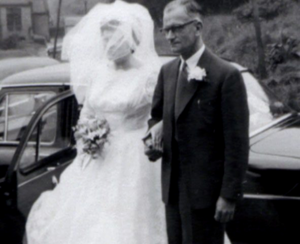
Doris Freeda, who later in life used Freeda rather than Doris, married Harold Lenton and they had two children. Ann was not a well child and spent much of her life being looked after by nuns at St Joseph’s Convent Howard Hill, Sheffield, and died at the age of 10. Wendy emigrated to Australia in the early 1960’s.
Amy Lillie wanted to become a nurse and would have liked to go to Liverpool to train but she told me that the vicar’s wife told Nora (Amy’s mother) that Liverpool was a wicked city and it would not be wise to allow her to go there. Amy went to Huddersfield and worked at the fever hospital in Meltham. While she was there she nursed a 12 year old boy called Harold Wilson who had political aspirations. He later became Prime Minister Harold Wilson. It was while she was working in Huddersfield that she met Thomas Cunningham.
Amy Lillie wanted to become a nurse and would have liked to go to Liverpool to train but she told me that the vicar’s wife told Nora (Amy’s mother) that Liverpool was a wicked city and it would not be wise to allow her to go there. Amy went to Huddersfield and worked at the fever hospital in Meltham. While she was there she nursed a 12 year old boy called Harold Wilson who had political aspirations. He later became Prime Minister Harold Wilson. It was while she was working in Huddersfield that she met Thomas Cunningham.
.
Amy Lillie married Thomas Cunningham at Wales Church on 23.08.1934. They had two daughters,
Shirley b.18.02.1936 Heather b. 26.09.1938
Nora died in 1937 at the age of 53 shortly after returning from Ireland having attended the funeral of her twin brother Dermot. Her husband George later remarried and he and his second wife, Evelyn, had a daughter.
George died 29.04.1951.
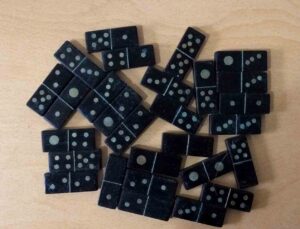
My mother, Amy Lillie, gave me these dominoes saying that she remembered her parents, George and Nora, playing with them when she was a child. They are obviously home made. I think the wood is lignum vitae. Could they be made from piano keys? The pips are created by what look like heads of brass nails. These would be readily availble in a mining area as brass does not create a spark which would be very dangerous underground. There are no '6's instead there is just one very large nail. They either ran out of small nails or found it too difficult to fit six in the space available.